A villa has walls an apartment does not: one that rises through two storeys in the stairwell, and a long one that follows the stair. In most projects these surfaces are simply plastered and painted, yet they are the largest walls in the house.
Relief gives these walls shadow, and the same surface reads one way in the morning and another in the evening. This guide covers which villa walls take relief, how daylight reads it and which decisions the choice depends on.
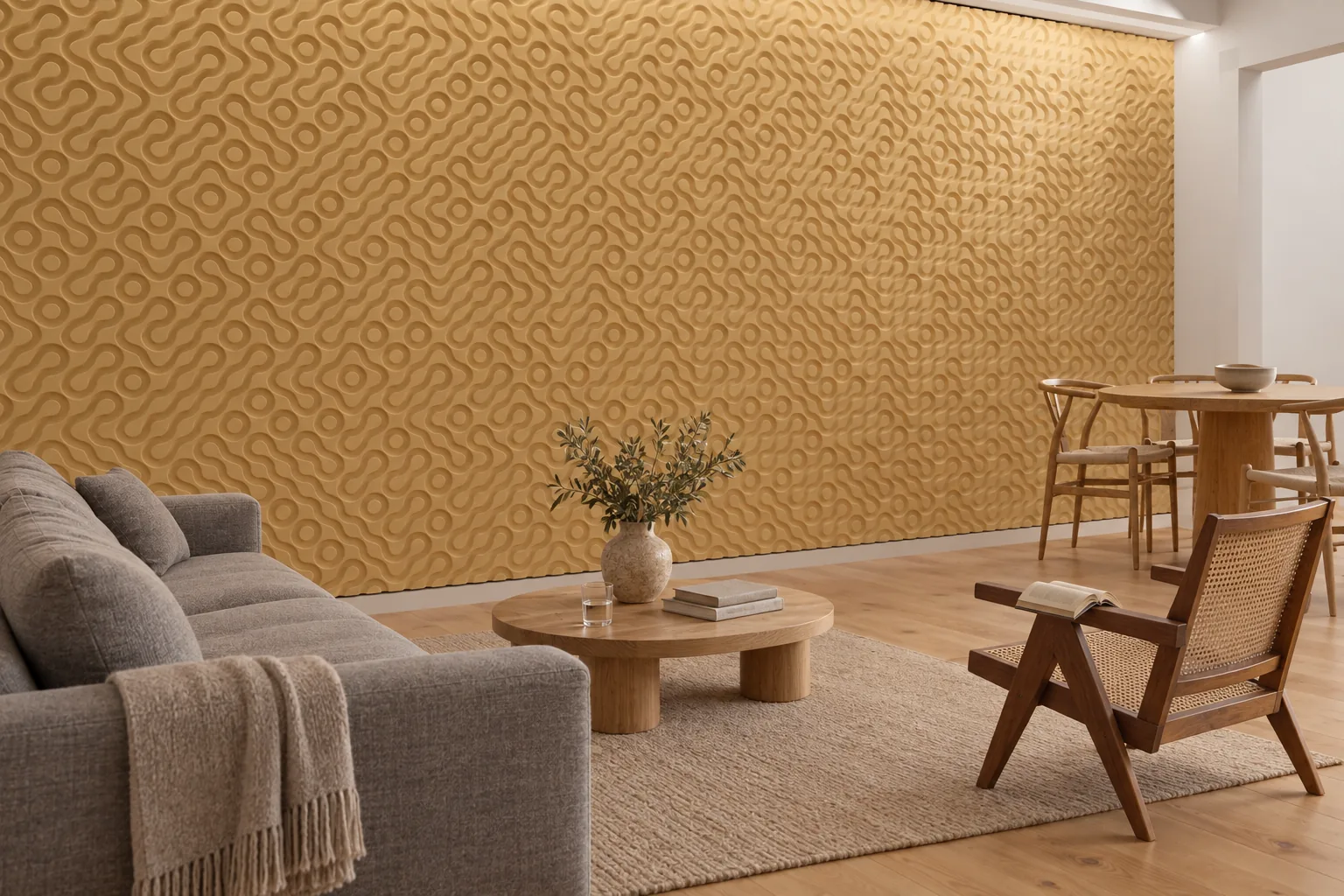
Relief in Daylight
In a villa the best light for relief is often the window. A large window standing at right angles to the wall grazes the surface from the side while it receives direct sun; as the angle of light moves, shadows lengthen, shorten and turn. The diffuse light of a north-facing window does not bring relief out to the same degree.
In the evening artificial light takes over. A linear fitting concealed at the ceiling that grazes the wall at 15 to 30 degrees brings the relief back; spots set far from the wall, or diffuse general light, flatten it. So the position of the window and the evening lighting should be considered together when the wall is chosen.
Which Wall, Which Relief
Living room. The wall behind the sofa is seen on entering the room and from the far end, a few metres away. A calm texture running the full width does well here, such as the vertical fibres of Glissando or the fine maze of Melisma.
Entrance hall. The entrance wall is seen briefly and from close by; a single panel can serve as the focal point here. Its height and position are set to eye level on the layout drawing.
Stair and stairwell. A wall rising through two storeys leaves room for the long shadows of a deep relief. The 40 mm coves of Fugato, on a wall that runs to the ceiling and takes light from the side, read as vertical shadow lines. If a handrail is to be fixed to the wall, the fixing points and the clear width of the stair are worked out on the layout drawing.
Bedroom. A wall at home is not cleaned every day as in a hotel, so a deeper relief can be chosen behind the bed too. The 10 mm limit that applies to guest rooms is covered separately in the hotel room wall design guide.
Studio Designs or Bespoke?
Studio Designs are relief we have drawn. The mould is made for your order and you approve the master before casting; lead time is 4 weeks after contract and advance, for orders up to 50 m².
If the wall starts from your drawing, that is Bespoke: we cast it the way you drew it. A line taken from the house’s architecture, a family motif or a sketch is enough to begin, and lead time is at least 6 weeks. Pieces that follow a curved stair wall, wrap a column or turn a corner are also cast as Bespoke in the same motif. Where a wall includes Bespoke pieces, plan the programme on the Bespoke lead time.
What the Wall Has to Carry
Panels are cast in Lumina PMAG™ — Polymer Modified Composite Gypsum — and they are heavy; panels with deeper relief weigh more. The type of wall behind them, particularly a metal stud and plasterboard partition, should be settled at the start of the project. The figures are collected in the weight and structural guide.
Pieces are fixed to the wall with a polymer adhesive, or with a rail system on metal stud and plasterboard walls. The panels are for interiors; exterior and continuously wet areas are outside their scope.
Surface and Colour
Pieces come paint-ready and are painted on site in the colour of the house. Matte surfaces show relief best; on a gloss, reflections sit where the shadow should be.
A raking-angle lighting specification goes with every delivery. Share your lighting plan early and the fitting’s offset from the wall and its angle are agreed before the ceiling is built.
How to Prepare a Brief
For a villa wall, the brief needs the following:
1. The wall. Its size, its place (living room, entrance hall, stair or stairwell) and its construction (brick, aerated concrete, reinforced concrete or plasterboard); a photograph if you have one.
2. The light. The orientation and position of the windows, and the lighting plan if there is one.
3. The design. A design from Studio Designs, or your own drawing.
4. The surface. Any colour preference.
From these we prepare a layout drawing. Delivery is ex-works Sapanca, Türkiye (EXW). Where the project needs it, Studio Luminant installs, quoted as a separate line per project.
Frequently Asked Questions
Which walls in a villa most often take relief?
The living-room wall behind the sofa, the entrance hall wall, the wall that follows the stair and the wall that rises through two storeys in a stairwell. Light on these walls changes direction through the day, so the shadows of the relief change with it.
How deep can relief be in a home?
In a home there is no 10 mm limit as there is for hotel rooms. Among the Studio Designs with a published depth, relief runs from 6 mm (Ricercar) to 40 mm (Fugato). Panels with deeper relief weigh more, so what the wall can carry should be checked at the start of the project.
Can relief be applied to a curved stair wall?
Yes, as Bespoke. Pieces that follow a curved wall, wrap a column or turn a corner are cast as Bespoke in the same motif; lead time is at least 6 weeks.
What are the lead time and fixing?
Studio Designs: 4 weeks after contract and advance, for orders up to 50 m². Bespoke: at least 6 weeks. Delivery is ex-works Sapanca, Türkiye (EXW), and installation, where needed, is quoted separately per project. Pieces are fixed with a polymer adhesive, following the installation drawing; metal stud and plasterboard walls take a rail system instead. Where the project needs it, Studio Luminant installs, quoted as a separate line.
Tell Us About Your Villa
Send the room, the wall dimensions and the timeline; we’ll read them and write back.
Send your drawing